
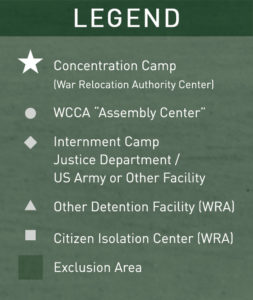
During World War II, the United States government excluded and removed approximately 117,000 Japanese and Japanese Americans (80,000 American citizens) from the West Coast of the United States, Alaska and parts of Arizona, under the authorization of President Franklin D. Roosevelt’s Presidential Executive Order 9066 (E.O. 9066) on February 19, 1942. The United States government, by the authority of military commander Gen. John DeWitt and under the guise of ‘military necessity,’ imprisoned Japanese and Japanese Americans living on the West Coast, in Alaska and in parts of Arizona first in “Assembly” Centers, pursuant to E.O. 9066. By October of 1942, the U.S. government had moved 110,000 people to ten semi-permanent new cities that the government named War Relocation Authority (WRA) “relocation centers,” as shown with stars on the map below.
The United States government, invoking the Alien Enemy Act of 1798, also would round up, detain and intern resident aliens of Japanese, German and Italian origin at the start of WWII into civilian internment camps run by the Department of Justice and Immigration and Naturalization Service (INS). Internees would include people who had lived for decades in the United States. Approximately 2,200 ‘enemy aliens’ – immigrants of Japanese descent were deported to the US from Latin American countries to internment camps in the US, around 1,800 were deported from Peru, with the rest coming from Bolivia, Colombia, Cost Rica, Cuba, Ecuador, El Salvador, Mexico, Nicaragua, Panama, and Venezuela. These Japanese Latin Americans were used as prisoners to exchange with the Imperial Japanese government for interned allied civilians, and after the war many of them were unable to return to their home countries who had denaturalized them or revoked their visas during the war. Some of those, often stateless people were deported to post-war Japan, the majority stayed in the United States; despite not having legal immigration status, they were granted ‘parole’ from immigration detention in 1946 and in 1952 the US government regularized the immigration status of the remaining Japanese Latin Americans. For more information see:
NJAHS: https://njahs.org/enemy-alien-files/
NARA: https://www.archives.gov/research/immigration/enemy-aliens/ww2
Known confinement sites include the ten WRA camps, along with temporary ‘assembly centers’, civilian internment camps run by INS/DoJ, US Army run camps, WRA Citizen Isolation Centers (used to house so-called ‘troublemakers’), other WRA facilities, as well as local jails and federal prisons where resisters to incarceration were held.
To browse by location on the map, click on a yellow icon.
This site provides a repository of information and images related to the War Relocation (WRA) Camps, Temporary “Assembly Centers,” Department of Justice Internment Camps, and U.S. Army Facilities with four types of images: 1) Architectural drawings, 2) Objects, 3) Engineering plans or maps made or related to the WRA Camps, 4) Documents, periodicals and photographs, 5) limited pre-war and post war materials related to those incarcerated in the camps, or to Japanese American relocation post-war.
Images on this site are provided as a research resource of primary graphic documentation of the built environments of the Japanese American Confinement Sites for students, teachers, researchers, and the public.
For a full list of WRA Camps, Temporary “Assembly Centers,” Department of Justice Internment Camps, U.S. Army Facilities, and other confinement sites please visit the History page.
For a list of objects from undetermined camps, click here.
Please send inquiry requests to njahs@njahs.org.
Oral Histories
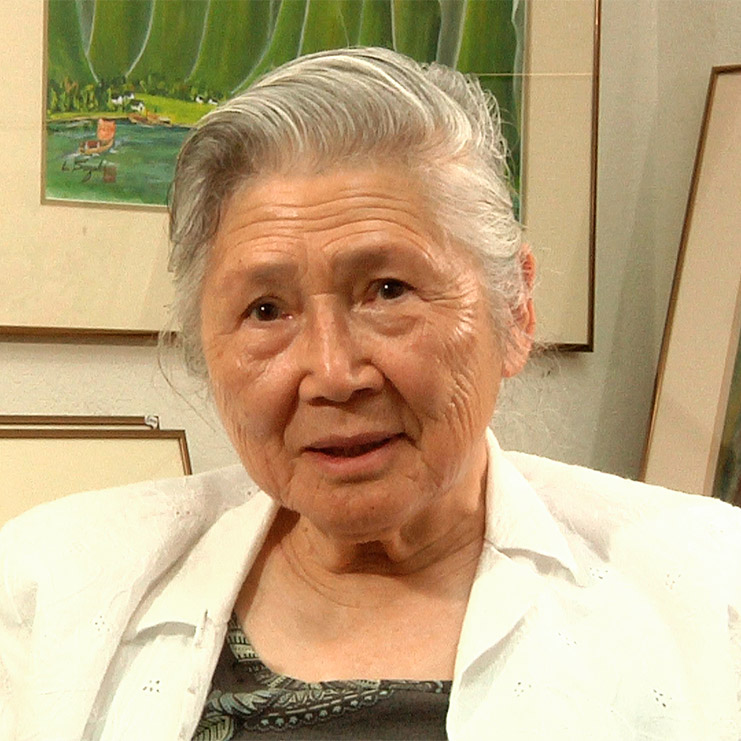

Browse the digital collection at the University of San Francisco Library.

This project is sponsored by the National Japanese American Historical Society.